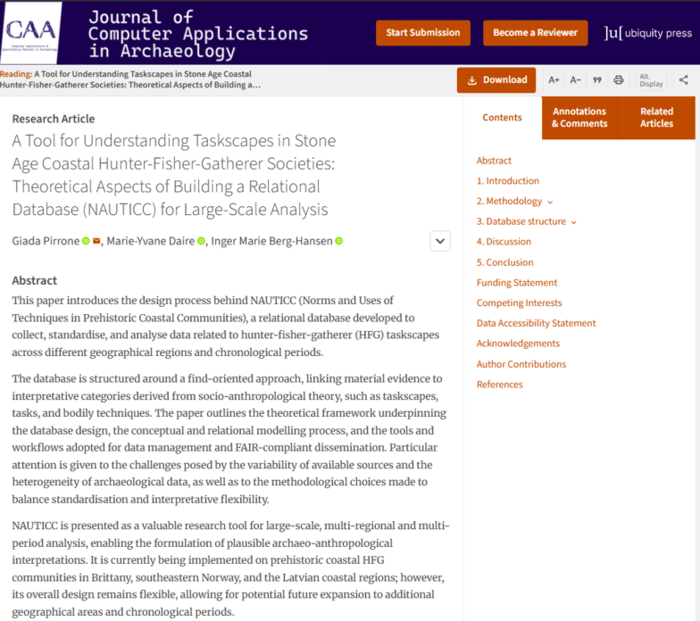
We are very pleased to share the news that the paper, "A Tool for Understanding Taskscapes in Stone Age Coastal Hunter Fisher-Gatherer Societies: Theoretical Aspects of Building a Relational Database (NAUTICC) for Large-Scale Analysis", which was submitted last year to the Journal of Computer Applications in Archaeology, has now been published!
News
Doctoral Candidate Amanda Sky spent one month in Latvia in both the capital city of Rīga and the broader Kurzeme region to collaborate with ArCHe colleagues, conduct fieldwork visits, and meet with heritage and environmental protections professionals. Amanda took every opportunity to explore the rich history of cultural heritage and environmental management in Latvia. She worked under the supervision of Dr. Valdis Bērziņš and further received guidance from documentary film director Marta Herca in developing her public dissemination film. Working alongside Doctoral Candidates Giada Pirrone (DC5) and Kevin Sleebos (DC6) made her secondment even more enriching
On Friday 25 September, between 17:00 and 22:00, ArCHe joined European Researchers' Night at the University of Latvia, a nationwide celebration of science that filled more than 30 venues across the country with exhibitions, presentations, and hands-on activities. This year's theme was “Living in the Future”. The Faculty of Humanities approached it by offering a deep-time perspective. Their activity showed how life along the Baltic coast from the Stone Age onward, in a broader European context, helps us understand how people survived environmental and social change.
ArCHe participated in this year’s Herring Day festival in Simrishamn, Sweden, a popular annual event that brings together museums, local organisations, researchers, and community groups for activities focused on fish, fishing, coastal environments, boats, and the importance of the sea. The project was invited by Ulrika Wallebom from the Österlens Museum, one of ArCHe’s associated partners.
ArCHe is pleased to announce that a new teaching resource has been added to The Classroom of Europe. The material, authored by DC Anass Butsch (CNRS), deals with The Role of Shells in the Daily Life of Prehistoric Hunter-Gatherers. It introduces pupils aged 10–12 to the importance of shellfish in Mesolithic coastal communities. Through accessible explanations, archaeological examples, and a hands-on shell-gathering activity, learners can explore how people lived along the Atlantic coast thousands of years ago.
ArCHe successfully participated at this year’s EAA-meeting in Athens, Greece, to disseminate diverse aspects of the project, get informed on other relevant research and outreach and not least to network internationally.
ArCHe PhD School 3 in Rennes, France, which encompassed PhD-course in “Marine resources and techniques” and a practical workshop on “Classifying marine remains”, conveyed a broad spectrum of interdisciplinary perspectives and practical approaches to the study of marine resources.
DC1 Julius Dimabayao recently finished his non-academic secondment at the Norges geologiske undersøkelse (NGU) from 19 May to 12 June, 2026 under the supervision of scientist-in-charge Dr. Anders Romundset. The month-long stay at the institution was part of his requirements in the ArCHe PhD program to practice interdisciplinarity and get a first-hand experience in the application of geology in the industry, and understand the field's intersections with archaeology and heritage studies.
In connection with its Scientific exchange meeting, the ArCHe-project was on a one-day excursion to the coastal area of Saint Gildas, Préfailles, Loire Atlantique, in Western France. This nature reserve placed directly at the coast is rich in archaeological sites, spanning from Mesolithic settlements and stone built fish-weirs to contemporary archaeological sites, such as remnants of World War II. The walk along the coast on this hot day in June gave also insight into coastal resources, biodiversity, the movement of the tides as well as problems of coastal erosion.
From June 16th to 18th 2026, DN ArCHe gathered for its Project Review and Scientific Exchange meeting at the University of Rennes, France. Organized by Catherine Dupont and Marie-Yvane Daire from beneficiary CNRS, the meeting was a great success, with the participation of the ArCHe beneficiaries, partners, DCs, and the External Advisory Board.
Doctoral Candidate Jasmine Mifsud attended the European Geosciences Union General Assembly (EGU 2026) in Vienna on 7 May, where she delivered an oral presentation entitled “Lost Pleistocene Territories: Exploration of Submerged Geomorphological Palaeo-Landforms along Northern Spain.” The presentation highlighted some of the most recent results of her doctoral research within the ArCHe Project, focusing on the study of this submerged landscape.
How can we activate archaeology for just futures? This was the overall question that guided the biennial meeting of the Nordic TAG (Theoretical Archaeology Group) 2026 held at Linnaeus University, Kalmar, Sweden, from May 6-9. To contribute to this topic ArCHe’s WP 5 organized the session Reaching Out – Calling upon Archaeology for a Habitable Future. The session had these main objectives: to discuss how archaeology can mobilize its potential “superpowers” in close cooperation with disciplines such as critical heritage studies and social anthropology, and to enhance our understanding of which sustainable, responsible, and just practices are needed for habitable futures, integrating the human and more-than-human.
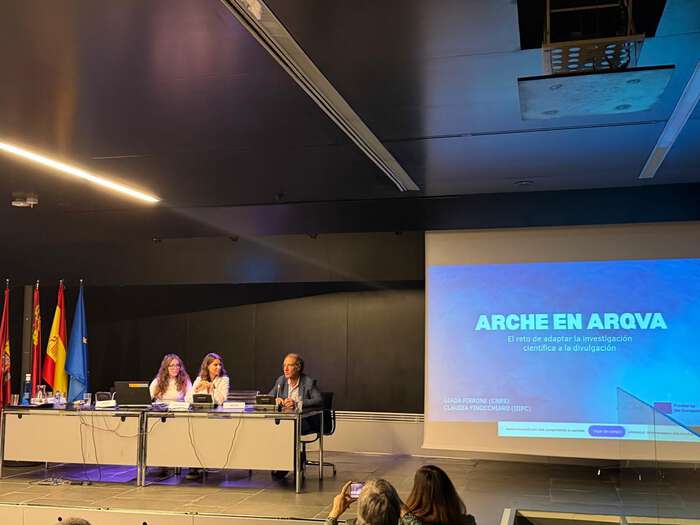
On 29 April 2026, ARQVA in Cartagena hosted the outreach event “Coastal and Underwater Prehistoric Heritage in Spain: the ArCHe Project and the Case of the Region of Murcia.” ArCHe DCs Giada Pirrone (CNRS) and Claudia Finocchiaro as well as Pablo Arias (both University of Cantabria), Esteban Álvarez Fernández (University of Salamanca) and Rocío Castillo Belinchon (ARQVA) from the ArCHe consortium, together with specialists from the Centre for Underwater Archaeology of Catalonia (CASC), the Ministry of Culture, and several Spanish universities, presented recent work on submerged prehistoric sites, conservation strategies, and coastal lifeways.
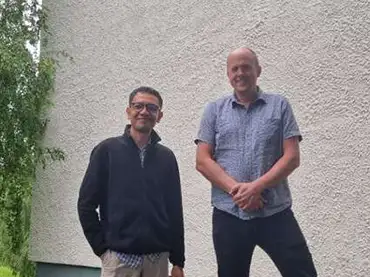
Interdisciplinarity is a core principle in the ArCHe programme. Hence, Julius, with a background in geology and coastal engineering has started his academic secondment in the Department of Archaeology at the Museum of Cultural History (MCH), University of Oslo.
Under the supervision of Prof. Dr. Steinar Solheim and working closely with Norwegian archaeologists, Julius is taking the opportunity to learn archaeological theory and practice, in order to investigate possible case studies of coastal Stone Age sites in Norway. He’s bringing concepts from climate science and risk in exchange of ideas with archaeologists and heritage researchers through participations in presentations and seminars conducted by the department, excursions, as well as discussions with peers and several experts on Stone Age studies.
These synergies help Julius in further developing a systematic and comprehensive climate risk assessment framework that aligns with heritage needs. Insights from this secondment also contribute to our understanding of the climate risk components: hazard, exposure, and vulnerability, and their interactions which affect the risk levels of archaeological sites and artefacts under dynamic environmental conditions due to climate change, so we can better protect and adapt these sites for the future.
HOME AT SEA - COASTAL ARCHAEOLOGICAL HERITAGE: A LEGACY BETWEEN PAST AND FUTURE (El mar como hogar, historias de vida en las costas prehistóricas) is the title of the newly opened panel exhibition at ArCHe’s partner ARQVA - The Spanish Museum for Underwater Archaeology in Cartagena, Spain. It presents aspects of prehistoric hunter-fisher-gatherer living with special focus on the Spanish evidence and explains the frame of the ArCHe-project. The exhibition is curated Rocío Castillo Belinchón from ARQVA and ArCHe Doctoral Candidates Claudia Finocchiaro (University of Cantabria) and Giada Pirrone (CNRS), who are currently on secondments at ARQVA. The exhibition is on from March 25, 2026, to September 2026 – and accessible all day. The exhibition-texts can be downloaded in four languages here on ARQVAs website.
The ArCHe project welcomes Kasper T. Juul-Dam who has taken over as new project manager for the Doctoral network on March 9th, 2026. Kasper is an experienced administrator of EU projects and has a background in M.A. studies in European history. The ArCHe-network looks very much forward to working with Kasper.
ArCHe doctoral candidate Rachel Runesson (DC10) is featured in the Swedish cultural heritage magazine Österlent, which recently published an article about her research and secondment at Österlens Museum in Simrishamn.
ArCHe was well represented at the 26th Symposium on Mediterranean Archaeology (SOMA), held in Cartagena, Spain, on 27–28 November 2025. The annual international conference gathers archaeologists and heritage professionals working to understand, protect, and communicate Mediterranean cultural heritage.
2026 is already shaping up to be a busy year for the ArCHe network. We start the year by highlighting two calls for papers for upcoming conference sessions co-organised by ArCHe researchers, both addressing coastal environments and long-term human engagement with dynamic seascapes.
Right before the season’s holidays ArCHe reaches an important milestone by submitting the first scientific deliverables to the EU.
Over the past year, several ArCHe doctoral candidates have spent time on secondment at CNRS in Rennes. These stays have brought them into close contact with French colleagues, local heritage management, and coastal Stone Age sites along the Atlantic.
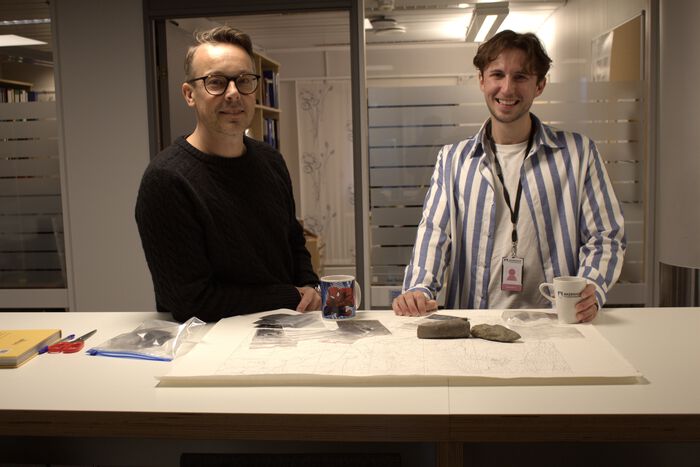
During the month of October, Jesper Gulliksen (DC8) has been on his non-academic secondment at the Section for Archaeology at Akershus County Council.
During the month of October, Rachel Runesson (DC 10) has been on her non-academic Secondment at the Museum of Österlen, partner in ArCHe, in the picturesque town of Simrishamn, south Sweden.
Last week, ArCHe doctoral candidates Kelly Gibbons and Jasmine Mifsud took part in the IKUWA-8 Conference in Oostende, Belgium – an international meeting dedicated to underwater and maritime archaeology.
The Call for Papers for the Session #1 “Reaching out – calling upon archaeology for a habitable future”, co-organized by ArCHe-members Almut Schülke, Anna Bohlin, Jesper Gulliksen, Rachel Runesson and Amanda Sky for the conference of the Nordic TAG (Nordic Theoretical Archaeology Group) Conference 2026 conference, is still open for submission of abstracts (deadline extended to October 22nd, 2025).